

How to choose a yoga mat
Not sure how to choose a yoga mat that’s right for you? Fear not. We’ve got you. There are six key criteria everyone should consider before deciding what mat to buy.
Just like the number of yoga and exercising styles may seem overwhelming, so can the sheer variety of mats. But with the right guidance, picking a mat is easy.
Here it goes. Let’s choose a yoga mat that’s right for you:
1. Type of exercise or yoga
More dynamic exercises and yoga like Ashtanga, Vinyasa and Hot Yoga are better suited for absorbent mats with an extra grip. Among natural materials, cork provides a naturally grippy surface, performs well even with moisture, and is generally well tolerated by sensitive skin. It’s also super easy to maintain, making it a very popular choice. Vegan Suede mats from recycled microfiber is a suitable alternative. Faux suede is super absorbent, anti-slip (faux suede is highly absorbent and tends to provide better grip as moisture increases during practice), and when you’re done, for regular care, simply wipe your mat with a clean cloth, or occasionally hand wash if needed. If you do Hot Yoga, consider a yoga towel or suede travel mat that fulfils the same function.
Less dynamic exercises, stretching, Yin Yoga and Hatha Yoga don’t require a specific mat. For less dynamic practices, a basic mat is often sufficient, as long as it provides enough grip and stability. Here you can let your visual preference guide your choices. Although when it comes to Yin Yoga where you hold positions for prolonged periods of time, digging your bones into the ground, mat thickness is an important factor. Thicker mats provide better comfort during Yin Yoga.
2. Material and sustainability
Material determines mat properties, ease of maintenance, sustainability aspects, and also plays a role in personal comfort and sensitivity.
If you, like us, find sustainability important, go with natural and / or recycled materials. Cork, rubber, jute, cotton, as well as vegan suede are all great options. If sustainability matters to you, you may want to consider whether the mat is biodegradable or recyclable.
The alternative is to go less eco and more synthetic like PVC, TPE and PU. PVC is durable and widely used, but its production and disposal are generally associated with a higher environmental impact compared to natural materials.
3. Your physique
To start with, the length of your mat should be enough to support you during savasana and lying down positions. Most standard mats are between 171 – 183cm long, although few brands offer extra long options.
Then there is thickness. Thinner mats provide minimal cushioning between you and the floor. Pre-existing conditions like joint problems should also be taken into account when deciding how to choose a yoga mat. If you have joint sensitivity, you may prefer mats with 3 mm thickness or more for added cushioning.
4. Where you exercise
Where you exercise is important. Home practice is logistically straightforward, and you can consider thicker and heavier mats, if that’s what you like.
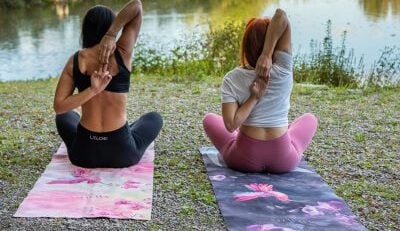
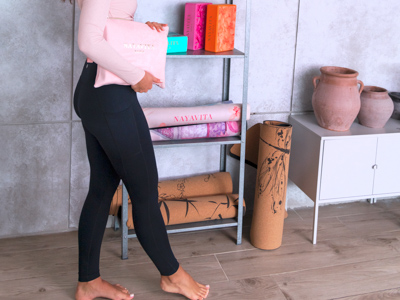
Studio nomads, outdoors enthusiasts and travellers might want to select thinner and lighter travel mat, especially when they come with their own pouch or a bag for extra portability.
5. Your style and aesthetics
It’s no secret that our environment impacts how we feel and think, so underestimating yoga mat aesthetics is not advisable. Surrounding yourself with an environment you enjoy can positively influence how you feel during your practice. It’s not a coincidence that our NAYAVITA YOGA motto, is
For the goddess in studio and out
6. Your budget
If your budget is limited, or you are just starting out and not sure if exercising is your jam, Amazon, AliExpress and Decathlon all have mats for as little as €10. If, on the other hand, you want to treat yourself to a mat that truly fits your needs and supports your practice, prices can climb up to four figures.
Higher prices don’t always mean better quality, although it is often the case. That doesn’t mean that you need to blow up your budget on an overpriced mat where you pay premium for the brand. Many boutique stores like NAYAVITA YOGA offer original, well-designed mats that combine functionality, comfort and aesthetics at accessible prices.
Mat comparison
Hopefully these six criteria shed some light on how to choose a yoga mat that’s right for you. To make it even easier, here is a comparison using these criteria:
| Cork mats | Suede mats | Travel mats | |
| Size | 181 x 61 cm | 183 x 61 cm | 173 x 61 cm |
| Thickness | 3.5 mm | 3 mm | 1 mm |
| Weight | 2.2 – 2.5 kg | 1.8 – 2.2 kg | 0.8 – 1.1 kg |
| Material | Cork & natural rubber | Recycled suede (microfiber) & natural rubber | Recycled suede (microfiber) & natural rubber |
| Joint support | High | Standard | Low |
| Best for | All yogis, including dynamic exercises (Ashtanga, Bikram, Pilates, etc.) | All yogis, including dynamic exercises (Ashtanga, Bikram, Pilates, etc.) | Yogis on the go |
| Biodegradable | Yes | Yes (natural rubber) | Yes (natural rubber) |
| Recycled | No | Yes (suede) | Yes (suede) |
| Recyclable | Yes | Yes | Yes |
| Hand-washable | No | Yes | Yes |
Namaste yogis!
Whatever your decision, remember that yoga mat does not determine your practice. Sure, it’s great having top of the range beautiful mat and matching gear. It can also be a priceless motivation. But lack thereof shouldn’t stop you from exercising here and now.
Sending you love and harmony!